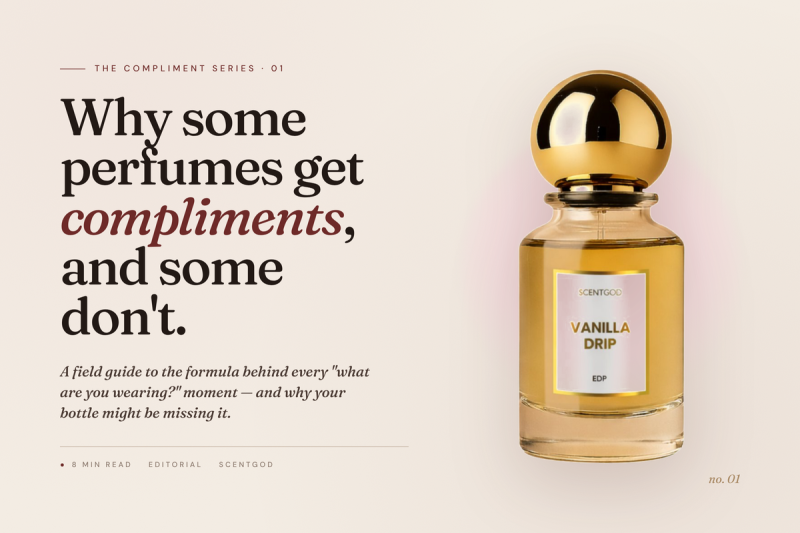
Why some perfumes get compliments — and some don't. The formula behind every "what are you wearing?"
Published: May 10, 2026 • Last Updated: May 10, 2026
Pull it together and the formula reads like this:
- Right notes (vanilla, caramel, soft musk, tonka, warm amber)
- Right projection (arm's-length sillage, not room-clearing)
- Familiar enough to feel instantly pleasant
- Distinctive enough to be remembered
- Built to work with your skin, not against it
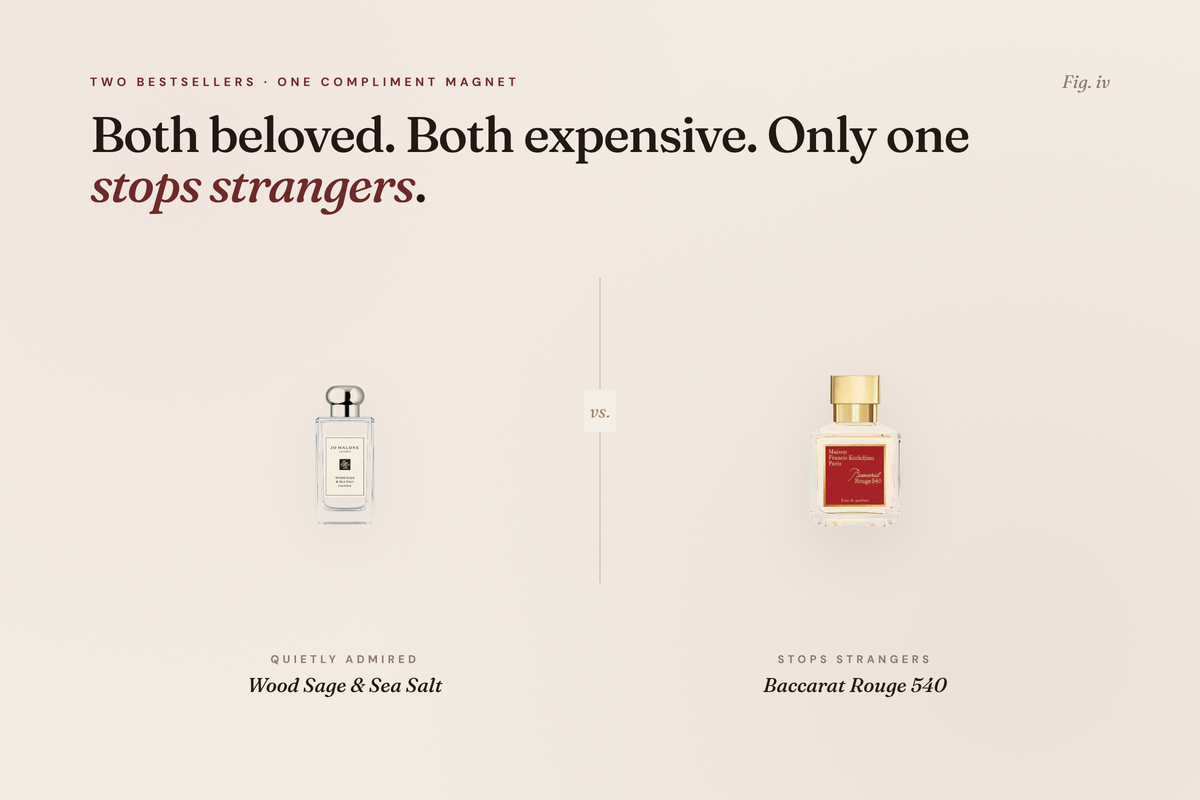
Real-world example: Baccarat Rouge 540 by Maison Francis Kurkdjian is the textbook compliment beast. Sweet, warm amber-jasmine-saffron, projects perfectly into the hug zone, instantly recognisable as "expensive but warm." It's basically the formula in a bottle.
Compare that to Jo Malone Wood Sage & Sea Salt — gorgeous perfume, sophisticated, beloved by its wearers, but it sits closer to the skin and reads cool, dry, and slightly herbal. It's an aesthetic. It's not designed to stop strangers. It's designed to feel like you. Both are excellent. Only one is built for the "what are you wearing?" moment.
How to actually wear a perfume so it gets compliments
You can have the right bottle and still wear it wrong. A few practical fixes that change everything:
Apply to pulse points and hair, not just clothes. Wrists, behind the ears, base of the throat, inner elbows — anywhere blood runs close to the surface gives off body heat that diffuses fragrance properly. A light mist on your hair is the secret weapon — hair holds scent for hours and broadcasts gently every time you move.
Don't rub your wrists together. It crushes the top notes and changes how the perfume opens. Spray and let it dry naturally.
Apply to moisturised skin. Dry skin doesn't hold fragrance. A quick layer of unscented body lotion (or your perfume's matching body cream) before spraying gives you significantly more longevity.
Re-apply mid-day. Most EDPs fade within 4–6 hours regardless of what the marketing claims. Keep a travel-size in your bag and refresh after lunch — that second application keeps the scent in the hug zone for the second half of the day, which is when most compliments actually happen.
Concentration matters. Eau de parfum (EDP) is generally the compliment sweet spot — strong enough to project, soft enough not to overwhelm. Eau de toilette (EDT) often dies too fast for compliments to land. Parfum/extrait can be too intense for everyday wear.
Don't over-apply. Two to four sprays is plenty for most EDPs. Six is too many. If people are commenting because they can smell you from the next office, that's not the compliment you want.
What to shop for if you want a compliment magnet
If you've read this far, you basically have a checklist. When shopping, look for:
- Notes weighted toward vanilla, caramel, soft musk, tonka, amber, or soft florals
- EDP concentration
- Reviews mentioning "lots of compliments" specifically (not just "smells good")
- Brands that let you try before you buy — trial sizes, samples, or money-back guarantees
- Mentions of Iso E Super or similar amplifying molecules
This is roughly the brief we used when building our perfume Vanilla Drip. We worked with feedback from over 18,000 Australian women to identify which note combinations most consistently triggered compliments, then formulated around them — vanilla and caramel at the heart, orange blossom and jasmine in the top, soft musk in the base. Then we boosted the formula with Iso E Super so it smells distinctively you on every wearer. In testing, 94% of women got compliments within the first hour of wear.
Try it on your own skin — that's the only test that actually matters. We do an 8ml trial size with a money-back guarantee for exactly this reason.
FAQ
Why don't people compliment my perfume?
Three common reasons. First, it's projecting outside the hug zone — either too quiet to register, or too loud and pushing people away. Second, the note profile is in the "respect" category rather than the "compliments" category (think oud, leather, or dry incense). Third, your application technique is killing the diffusion (rubbing wrists, applying only to clothes, applying to dry skin). Try a softer-warmer scent at EDP concentration, applied to pulse points and hair on moisturised skin, and you'll see different results within a week.
What perfume gets the most compliments?
Statistically, perfumes built around vanilla, caramel, soft musk, and warm amber. The most-cited examples online are Baccarat Rouge 540, Cloud by Ariana Grande, Kayali Vanilla 28, Phlur Missing Person, Tom Ford Lost Cherry, and Sol de Janeiro Cheirosa 62. ScentGod's Vanilla Drip sits in the same category and was specifically built around feedback about which notes pull the most compliments.
Why does my perfume smell different on me than on my friend?
Skin chemistry. Your skin's pH, oil levels, diet, and hormones all shift how a fragrance develops. The same vanilla can smell creamy on one person and almost saccharine on another. There's no fix for this except trying perfumes on your own skin before buying — which is why trial sizes and samples are worth seeking out.
How do I make my perfume get more compliments?
Apply to pulse points and hair (not just clothes), make sure your skin is moisturised first, don't rub your wrists, use EDP concentration, and re-apply once mid-day. If your perfume is heavy on oud, leather, or incense, consider switching to something with vanilla, caramel, or soft musk — the note profile matters more than the brand or the price.
Do certain notes get more compliments than others?
Yes, and the difference is significant. Sweet-warm notes (vanilla, caramel, tonka, amber) and soft musks consistently get the most compliments across cultures. Heavy bases (oud, leather, big patchouli) and aldehyde-heavy classics get fewer compliments but more "respect" reactions. Soft florals are mid-range — jasmine and orange blossom in moderation pull compliments; big tuberose or rose tend to polarise.
Skin chemistry is real. It's not a myth invented to sell you more bottles.
Your skin's pH affects how the top notes open. Your skin oil determines how long a perfume lasts and how its base develops. Your diet shifts the warmth and sharpness of the dry-down — eat a lot of garlic, curry, or coffee and your fragrance will read sharper. Hormones tilt it again — perfumes can smell measurably different on you premenstrually, during pregnancy, or post-menopause. Even some medications change your fragrance experience.
This is why blind-buying perfume is risky. Reviews are useful, but they're written by that reviewer's skin, not yours. The bottle your friend swears by might smell flat, sharp, or syrupy on you. The bottle that gets you compliments might do nothing for her.
The lesson: try before you commit. Sample, decant, scent-strip, store-test. And when you're shopping online, look for brands that offer trial sizes — that's the modern version of the old department-store sample.
There's one more layer here worth knowing about. A class of synthetic molecules called
Iso E Super (sometimes marketed as "attraction molecules") behaves differently from traditional notes. Instead of having a fixed smell, it amplifies whatever's around it and shifts subtly with each wearer's chemistry. Perfumes built around it tend to smell distinctively yours on you, which is exactly what you want for compliment generation. It's why so many modern compliment-magnet fragrances feature it prominently.
So what does a "compliment perfume" actually look like?

You bought the perfume. You loved it on the strip in the store. You wear it for a week. And… nothing. No "what are you wearing?" No leans-in. No mum doing a double-take when you walk into the room. Just silence.
Meanwhile your friend is wearing something half the price and getting compliments at the supermarket.
If you've ever wondered why some perfumes get more compliments than others, here's the news: it's not random. It's not bad luck. It's not even (mostly) your skin "ruining" perfumes. Compliment perfumes follow a formula, and once you can see the formula, you'll never blind-buy the wrong bottle again.
Here's the breakdown.
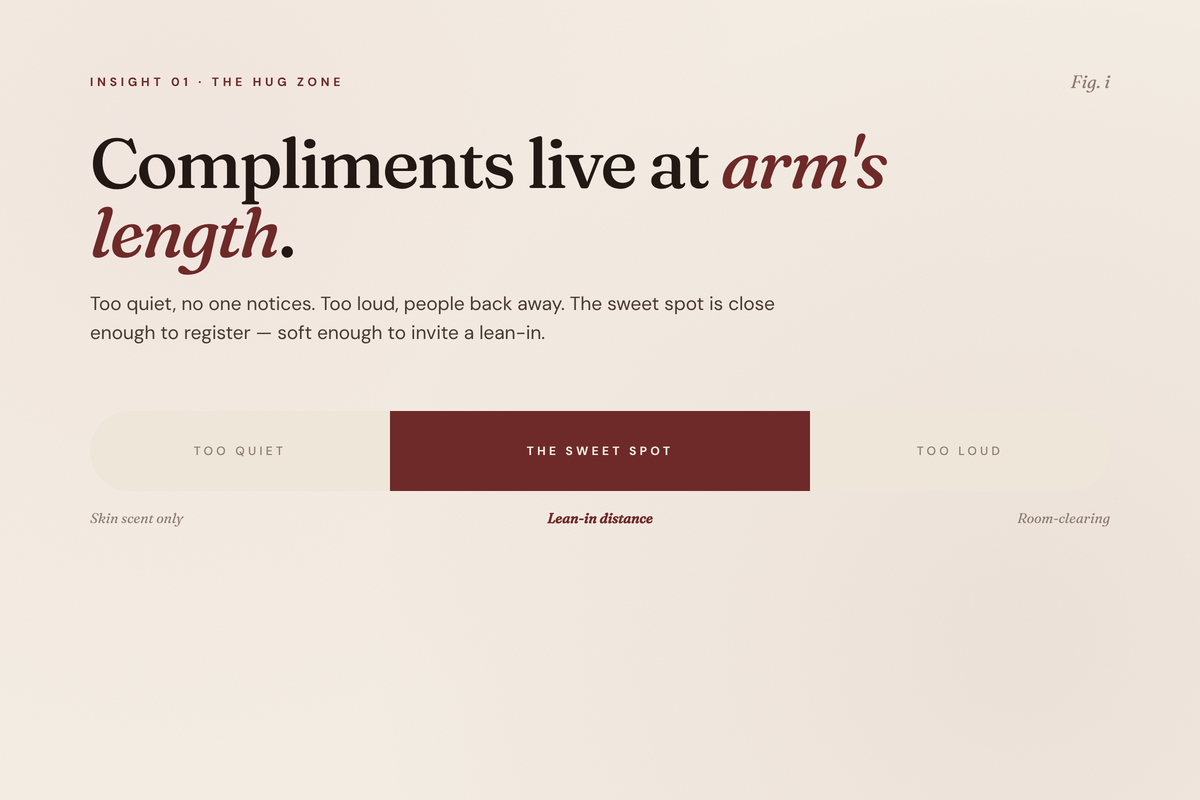
Compliments live in the hug zone
Most fragrance reviews talk about sillage (the trail a perfume leaves) and projection (how far it travels off your skin) as if more is always better. They aren't.
Think of it as a zone. There's the skin scent zone, where a perfume only smells good if you bury your face in your wrist. There's the room-clearing zone, where the smell hits people from ten feet away and makes them physically step back. And there's the sweet spot in between — about an arm's length — where someone close enough to chat can register the scent without being overwhelmed by it.
That sweet spot is where compliments happen. Too quiet, and no one notices. Too loud, and people back away instead of leaning in. Hugs, close conversations, sharing a coffee — those are the moments compliments get triggered. So a perfume tuned for compliments has been built to land in that arm's-length zone, not to fill the whole room.
This is why expensive heavy-projection perfumes often get fewer compliments than mid-tier "softly loud" ones. The technical word is sillage, and you want yours in the Goldilocks range: present, but not assaulting.
Familiar enough to love. Distinctive enough to remember.
Your brain takes about a second to decide whether a smell is "good." That second is where compliments are won or lost.
Too unique, and the brain hesitates — what is that? isn't always followed by a compliment. It's sometimes followed by a polite step backwards. Big oud, deep leather, dry incense, screaming aldehydes — these are perfumes that command respect. The kind of respect that gets you nominated for a leadership position, not stopped in the cereal aisle.
Too generic, and the brain doesn't bother registering it at all. If you smell exactly like every fifth woman in the queue, your fragrance is invisible. No one comments because it's wallpaper.
The compliment sweet spot is what fragrance people call the familiar-distinctive axis. The scent has to feel instantly pleasant — soft, warm, sweet, clean, something the brain recognises and approves of within that crucial first second. But it also has to be specific enough that the wearer feels memorable. "Oh, that's lovely" is good. "Oh that's lovely — what is it?" is better.
This is why niche-feeling-but-friendly perfumes outperform both ultra-luxe niche scents and mass-market crowd-pleasers in actual compliment frequency. They walk the line.
Some notes get compliments. Some get respect.
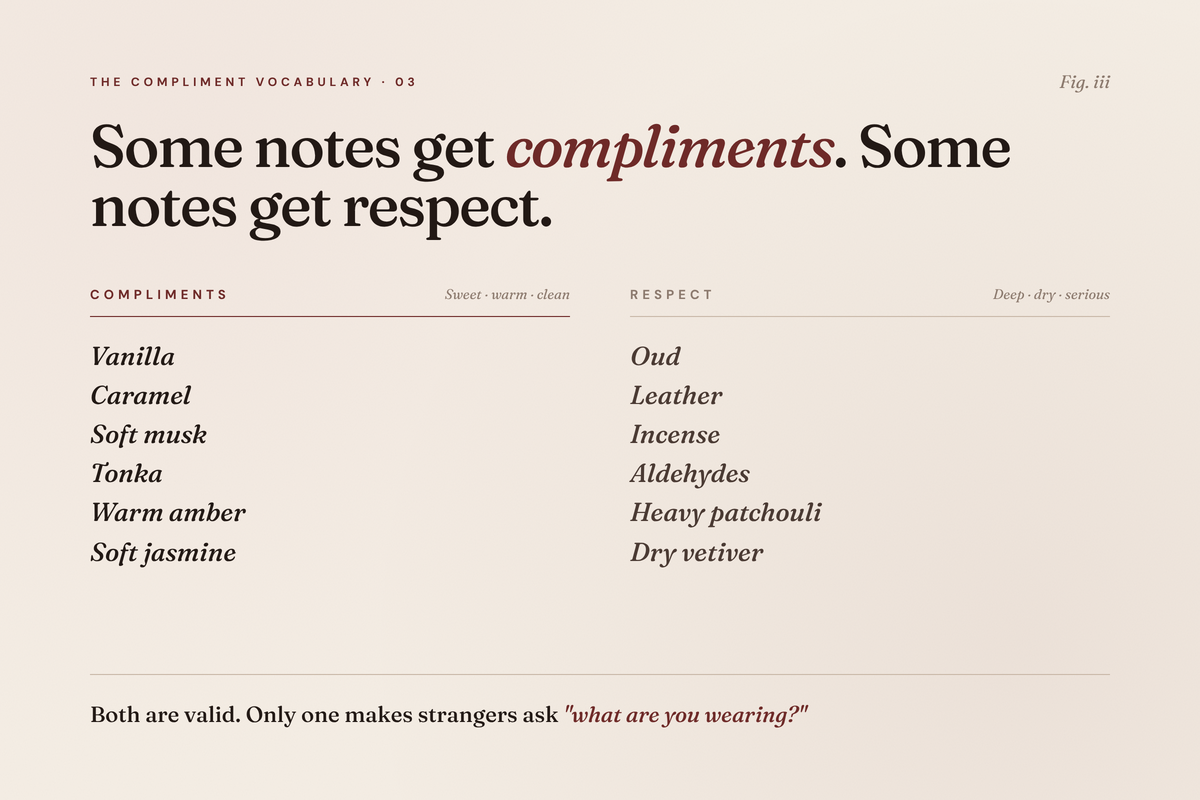
Here's the part nobody wants to admit: certain notes statistically pull compliments. Other notes statistically pull respect (or worse — silence). Both are valid, and your fragrance taste is your business, but if compliments are what you're after, the chemistry is real.
Notes that get compliments:
- Vanilla (the universal love language)
- Caramel and praline (gourmand-adjacent without being dessert)
- Soft musk (clean, intimate, body-warming)
- Tonka bean (almondy, sweet, cosy)
- Warm amber (golden, sun-drenched, glowing)
- Soft florals like jasmine and orange blossom (in moderation)
- Coconut and tropical notes (especially in summer)
Notes that get respect (but rarely compliments):
- Heavy oud
- Leather and suede
- Incense and church smoke
- Aldehydes (the Chanel No. 5 vibe)
- Big patchouli (the "head shop" association is real)
- Earthy, mossy, herbaceous notes
This isn't aesthetic snobbery — it's borne out by fragrance research. Cross-cultural studies on scent preferences consistently find that bright, sweet, and warm notes outperform heavy bases like musk and patchouli when it comes to broad pleasantness ratings. Master perfumers know this. The most-complimented perfumes in the world are deliberately built for broad emotional appeal, not creative experimentation. That's not laziness — that's the whole point.
So if you've been wondering why don't I get compliments on my perfume? and your bottle is heavy on oud, leather, or smoke, that's your answer. Beautiful perfume. Wrong category for the goal.
Same bottle, different skin, different result
Never miss another article!
- - Get notified when we publish a new article.
- - No personal information required. Turn off anytime

Olivia Beaufort
Hi I'm Olivia Beaufort, a blend of French elegance and Australian charm! I love fragrances! I have an impeccable nose for identifying notes on other people. I have been using ScentGod for years and built quite a collection for myself. Now, I share my experiences and my knowledge in the world of perfumes.
Read MoreYou may also like
-
![]()
Best Vanilla Perfume for Compliments (2026): Why "Vanilla Drip" Hits Different
-
![]()
The Secret Weapon Your Perfume Didn't Know It Needed
-
![]()
Simply the Best Pheromone Perfume in the World for Compliments – Try Compliment Magnet